
What are the advantages and disadvantages of tempered glass
Tempered glass is a type of safety glass. In fact, it is also a type of prestressed glass. To improve the strength of glass, chemical or physical methods are generally used to form compressive stress on the surface of the glass. When the glass receives external force, the surface stress is first counteracted, and then the load-bearing capacity is improved, enhancing the glass's resistance to wind pressure, heat and cold, impact, etc.
Tempered glass is made by heating high-quality float glass close to its softening point and rapidly cooling it on the surface of the glass, causing compressive stress to spread on the surface of the glass and tensile stress to occur in the central layer. Because there is a strong and equal compressive stress, the tensile stress generated by external pressure is offset by the strong compressive stress of the glass, thereby increasing the safety of the glass.
Tempered glass has the following characteristics:
1. Strength improvement: The mechanical strength, impact resistance, and bending strength of tempered glass can reach 4-5 times that of ordinary glass.
2. Improved thermal stability: Tempered glass can withstand large temperature differences without breaking, and can resist temperature changes to be three times thicker than ordinary float glass of the same thickness. Acceptable temperature difference of 150 ℃ has a significant effect on preventing thermal cracking.
3. Safety improvement: After tempered glass is subjected to strong damage, small blunt angle particles quickly appear, ensuring maximum personal safety. Application: Furniture, electronic and electrical professions, construction and decoration professions, bathhouses, cars, escalators, and other places with special safety requirements and temperature fluctuations, and can be used as raw materials for insulating glass and laminated glass.
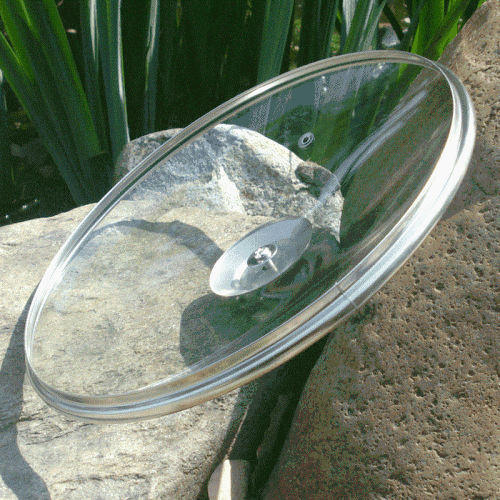
Usage:
Flat tempered glass and curved tempered glass are classified as safety glass. Widely used in high-rise building doors and windows, glass curtain walls, indoor partition glass, daylighting ceilings, visiting elevator passages, furniture, glass guardrails, etc.
Defects and deficiencies of tempered glass:
1. Tempered glass cannot be cut or processed anymore. It can only be processed to the required size and shape before tempering.
2. Although tempered glass has stronger strength than ordinary glass, it has the possibility of self explosion (self rupture) when there is a large temperature difference, while ordinary glass does not have the possibility of self explosion.
After tempering, the mechanical strength of the glass surface is 3 to 5 times higher than that of ordinary glass, but the edges and corners of tempered glass are relatively fragile and may break when subjected to external forces. Additionally, if the external temperature frequently changes, tempered glass may also self destruct. The editor reminds everyone that when using tempered glass products, they should be careful not to bump the edges and corners. It is recommended not to let the glass temperature change dramatically in a short period of time to avoid self explosion.
In addition, the central part of tempered glass is the strongest, while the corners and edges are the weakest. If there is an emergency, the tempered glass can be broken to escape. The best way is to use a safety hammer or other sharp hard block to strike the edges and corners of the glass, especially the center of the top edge of the glass. Once there is a crack in the glass, it is easy to smash the entire piece of glass.
Article source: Tempered glass coverwww.yinghuade.com
-
12-03
Tempered Glass Cover: How to Clean Glass Pot Cover
1. Flour has a strong adsorption effect and can absorb and remove oil stains from the pot lid. The specific steps are to evenly apply flour to the surface of the pot lid, and the amount of flour used
-
12-03
Glass cap manufacturer: Reasons and solutions for foaming of glass bottles after high-temperature spray painting
The primary reason for the foaming of glass bottles during high-temperature spray painting is:1. The coating comes into contact with water or is exposed to high temperatures;2. The solvent evaporates
-
12-02
Silicone pot cover: What is the difference between acrylic panel and glass panel
Distinguishing by chemical properties:Acrylic panels are classified as organic glass panels, which are synthetic plastic panels; Glass panels are classified as inorganic panels.From the perspective of
-
12-01
Market demand for tempered glass covers
The market demand for glass covers will increaseThe material conditions of modern society have been greatly satisfied, and the production of more and more materials and products has reached market sat
Copyright © 2026 Jiangmen Yinghua Technology Industrial Co., Ltd All rights reserved